A single implant placed with CBCT planning, digital design, and board-certified surgical precision is a permanent solution — not a temporary fix.
Book NowA single tooth implant begins with a CBCT 3D cone-beam scan — not a standard 2D X-ray — showing exact bone volume, density, and anatomy at the implant site. Implant planning software positions the implant virtually and optimizes its position, depth, and angle before surgery. The final crown is designed from 3D intraoral digital scans — no goopy trays, no guesswork.
Book Now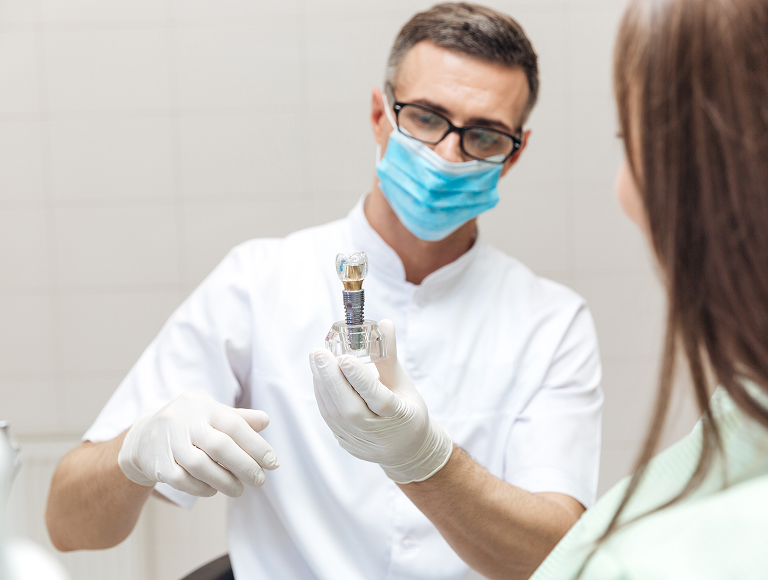
A traditional bridge requires grinding down two healthy adjacent teeth. A partial denture moves when eating and does nothing for bone preservation. A single implant replaces the root itself. Osseointegration — the biological fusion of titanium with living bone — is what gives implants their permanence. It is not adhesive or mechanical retention; it is bone growing into the implant surface at the microscopic level.
Implant Fixture: A titanium dental implant placed into the jawbone, integrating over 6–12 weeks
Abutment: A precision connector designed digitally to optimize crown emergence profile and gum tissue health
Crown: A zirconia or PFM restoration fabricated from 3D intraoral digital scans, matched to adjacent teeth in shape, color, and translucency
Alveolar bone exists because of the mechanical stimulation teeth provide. When a tooth is lost, stimulation stops — within the first year, up to 25% of bone volume at the extraction site can be lost. Adjacent teeth drift and tilt; the opposing tooth may super-erupt.

Single tooth implants placed with proper protocol have among the highest success rates of any dental procedure — consistently above 95% at 10 years.

Schedule a consultation at Tuscaloosa Dentures and Implants today.
Free Implant Consultation
Your consultation and 3D CBCT scan are completely free — so you know exactly where you stand before deciding anything.