When a tooth is extracted and not replaced promptly, bone resorbs both vertically (height) and horizontally (width). In the first six months, patients can lose 25% or more of original ridge width. The result is a "knife-edge" ridge — enough height but too thin (often 3mm or less) for a standard 4–5mm-diameter implant. Ridge augmentation is typically recommended when width falls below 5mm at the planned site.
Book Now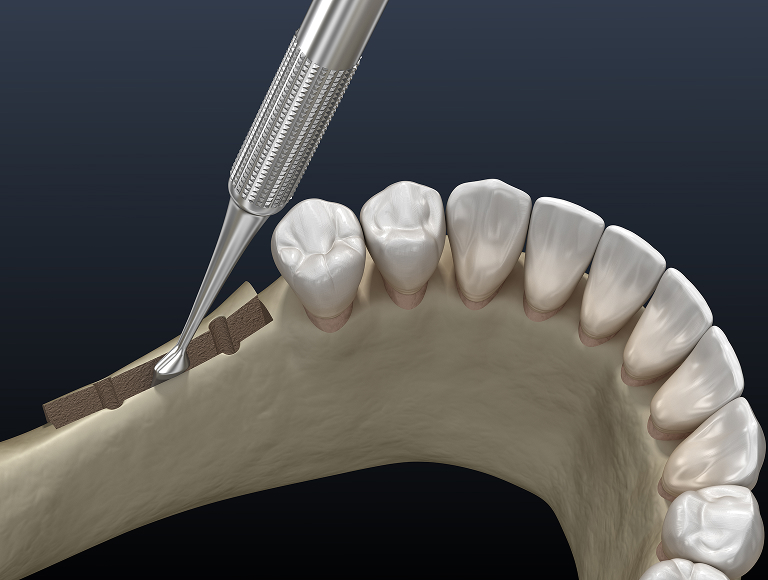
Two main surgical approaches are used depending on the size and nature of the defect.
Guided bone regeneration (GBR): The most common approach — particulate graft material placed against existing bone, a barrier membrane positioned over it, gum closed over the site. Over 4–6 months, the body remodels the graft into living bone.
Block grafting: Uses a solid bone block (autograft or tissue-bank processed) fixed to the ridge with titanium screws. Reserved for larger defects. Healing similar (4–6 months) but greater surgical complexity. For both techniques, the implant is placed in a second appointment after the graft matures.
Performed under local anesthesia or IV sedation. Day 1–3 most discomfort, moderate swelling peaking day 3–4, resolving over the following week. Soft foods recommended 7–10 days; follow-up at 2 weeks for suture removal.
Book NowTypical timeline: Month 0 consultation/imaging → Month 1 ridge augmentation surgery → Months 2–6 integration/healing → Month 6 implant placement → Months 6–10 osseointegration → Months 10–11 crown/bridge placement. Total treatment time typically 10–12 months — which is why socket preservation at time of extraction is encouraged to prevent needing this later.
Book NowUnder local anesthesia or IV sedation, the procedure itself is painless. Recovery involves moderate swelling/discomfort for 3–7 days.
4–6 months after ridge augmentation, depending on size and integration progress.
Sometimes, if the ridge is borderline-adequate; most cases require staged treatment.
Schedule a consultation at Tuscaloosa Dentures and Implants today.
Free Implant Consultation
Your consultation and 3D CBCT scan are completely free — so you know exactly where you stand before deciding anything.