

A missing tooth can affect much more than the appearance of a smile. It may change how a person chews, speaks, or feels in social situations. When several teeth are missing, everyday foods can become difficult to enjoy, and a removable denture may not always provide the desired stability.
Dental implants offer another way to replace one tooth, several teeth, or an entire arch of teeth. Because implant treatment can seem complicated at first, understanding the basics can make the decision feel more manageable.
This guide explains what patients should know when considering dental implants in Tuscaloosa, AL, including available restoration types, treatment stages, comfort, candidacy, and questions to ask during a consultation.
This article provides general educational information and is not a diagnosis or personalized treatment recommendation. A dental professional must evaluate oral health, medical history, and imaging to determine whether implant treatment is appropriate.
What Is a Dental Implant?
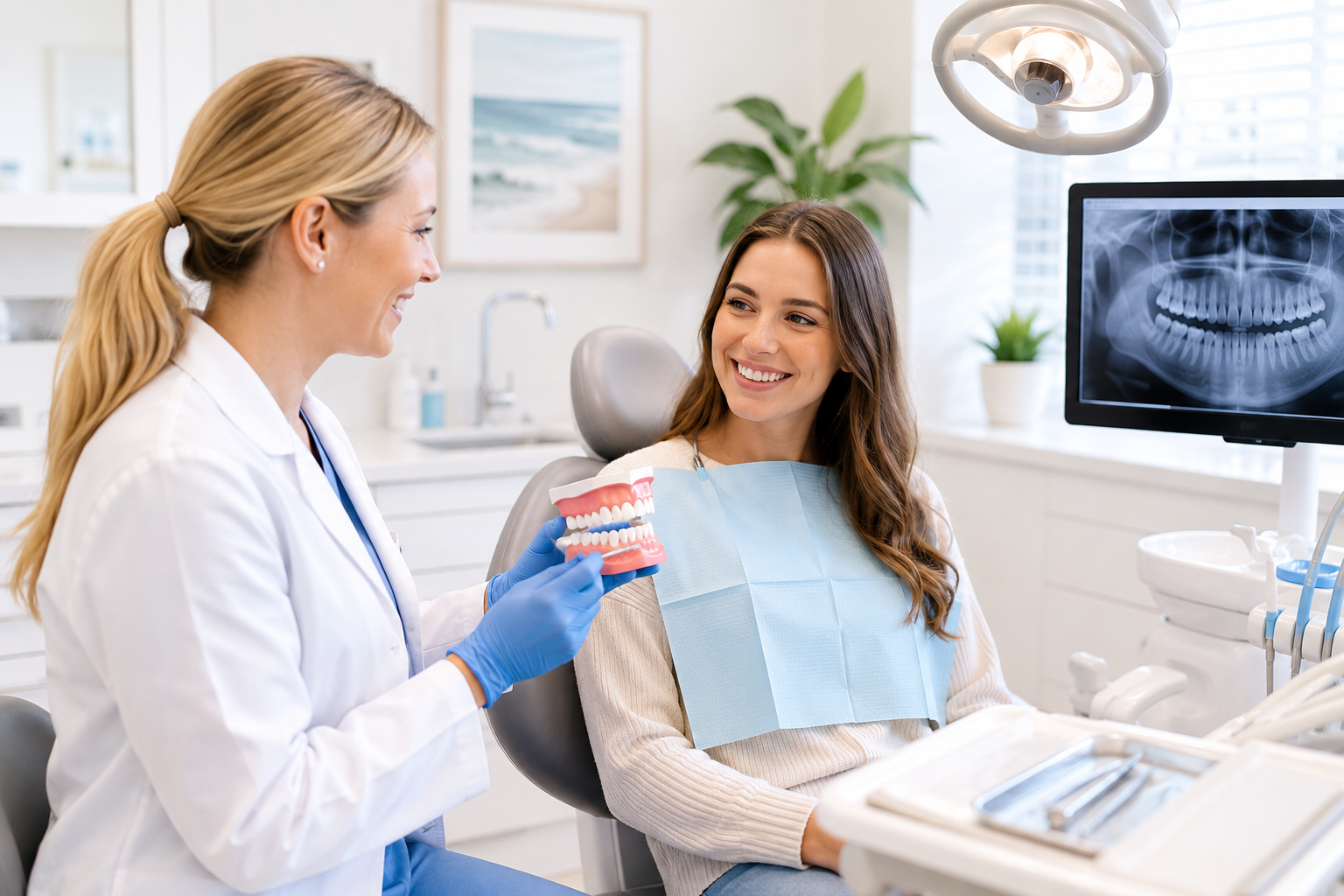
A dental implant is a small post placed in the jaw to act as an artificial tooth root. Most modern implants are made from biocompatible materials such as titanium. After placement, the surrounding bone can gradually form a stable connection with the implant through a biological process known as osseointegration.
The implant is only one part of the finished restoration. Depending on the treatment plan, it may support:
- A crown for one missing tooth
- A bridge replacing several neighboring teeth
- A removable implant-supported denture
- A fixed full-arch bridge
Unlike a traditional bridge, a single-tooth implant usually does not require neighboring teeth to serve as the primary support. Implants can also help stabilize full-arch restorations, reducing the movement that some patients experience with conventional dentures.
Common Types of Dental Implant Treatment
There is no single implant solution that fits every smile. The appropriate option depends on how many teeth are missing, the condition of the remaining teeth, available bone, health history, and personal goals.
Single-tooth implants
A single implant may replace one missing tooth without relying on the adjacent teeth for support. Once the implant is ready for restoration, an abutment and custom crown are attached to create the visible portion of the tooth.
Implant-supported bridges
When multiple teeth are missing in the same area, strategically placed implants may support a bridge. This can replace several teeth without requiring one implant for every missing tooth.
Implant-supported dentures
An implant-supported denture connects to implants for greater stability than a conventional removable denture. Some designs remain removable for cleaning, while others are fixed and must be removed by a dental professional when appropriate.
Tuscaloosa Dentures & Implants provides implant-supported denture options for patients seeking improved denture support. The recommended design depends on anatomy, hygiene needs, dexterity, expectations, and budget.
Full-arch implant restorations
Patients who have lost most or all teeth in an upper or lower arch may be considered for a full-arch restoration supported by several implants. These treatments are sometimes described as All-on-4 or All-on-X, although the number and position of implants must be personalized.
The practice offers All-on-4 and All-on-X treatment in Tuscaloosa. Not every patient needs the same approach, and retaining healthy natural teeth may be preferable when clinically appropriate.
Same-day implant options
“Same-day” treatment generally means an implant or temporary restoration may be placed during the same visit under suitable conditions. It does not mean that the implant has completed biological healing that day.
A temporary tooth must be protected while the bone forms a stable connection with the implant. Final teeth are typically provided only after the dentist confirms that the implant and surrounding tissues are ready. Patients interested in this approach can learn about the practice’s same-day dental implant options, but candidacy requires an examination and imaging.
What Happens During the Implant Process?
Implant care is completed in stages. Some stages may be combined, while others need to occur separately so the mouth can heal properly.
1. Consultation and planning
The dental team reviews the patient’s concerns, medical history, medications, current teeth, gums, bite, and previous dental treatment. Three-dimensional imaging may be used to evaluate the jawbone and nearby structures and to plan implant position.
This appointment is also the right time to discuss restoration choices, sedation or comfort options, estimated fees, insurance, financing, maintenance, and alternatives to implants.
2. Preparatory care, if needed
Some patients can proceed directly to implant placement. Others may first need treatment for active gum disease, removal of a non-restorable tooth, or a bone-building procedure. Needing preparation does not automatically rule out implant treatment, but it can change the sequence and overall treatment timeline.
3. Implant placement
During placement, the area is numbed, and the implant is positioned according to the treatment plan. Sedation may be available when appropriate. The dentist then provides instructions for protecting the area and managing expected postoperative symptoms.
4. Recovery and healing
It helps to separate the different meanings of “healing.” Early recovery refers to the initial period when tenderness, swelling, or minor bleeding settles. Soft-tissue healing involves the gum tissue closing and maturing around the treatment site.
Osseointegration is a separate, deeper process in which bone forms a functional connection with the implant surface. A person may feel comfortable before this process is complete. The dental team therefore evaluates stability and healing rather than relying only on how the area feels.
Completion of treatment is another milestone. The final crown, bridge, or denture may be delivered only after the implant and oral tissues are considered ready. The total timeline varies according to bone quality, the number of implants, preparatory procedures, health factors, and whether a temporary restoration is used.
5. Final restoration and maintenance
After healing, the implant receives its final restoration. The dental team checks appearance, fit, bite, comfort, and access for cleaning. Implant restorations cannot develop cavities in the same way natural enamel can, but plaque can still inflame the surrounding gums and bone. Daily home care and professional maintenance remain essential.
Who May Be a Candidate for Dental Implants?
Many adults with missing or failing teeth can be evaluated for implants. Age alone does not determine candidacy. Dentists focus more on oral health, bone support, healing capacity, medical history, and whether the patient can maintain the restoration.
Factors considered during an evaluation may include:
- The number and location of missing teeth
- Jawbone volume and quality
- Gum health and oral hygiene
- Smoking or nicotine use
- Diabetes and other medical conditions
- Medications that may affect bone or healing
- Teeth grinding or heavy bite forces
- Ability to attend follow-up and maintenance visits
These factors do not always prevent treatment, but they can affect planning and risk. Patients should share a complete medication list and health history rather than assuming a condition is unrelated to dental care.
Comfort, Risks, and Realistic Expectations
Local anesthetic is used to numb the treatment area during implant placement. Depending on the procedure and patient needs, additional comfort or sedation options may be discussed. After treatment, temporary soreness, swelling, bruising, or minor bleeding may occur.
As with any surgical procedure, dental implant placement has risks. These may include infection, delayed healing, injury to nearby structures, gum recession, implant instability, or failure to integrate. Full-arch and upper-jaw procedures can involve additional anatomical considerations. Careful planning and follow-up help manage risk, but no clinician can guarantee a particular outcome.
Patients should contact their dental team promptly if symptoms worsen rather than improve, bleeding cannot be controlled, a temporary restoration feels loose, or they develop signs that concern them. Urgent or severe symptoms require prompt professional evaluation.
How to Compare Dental Implant Options in Tuscaloosa
Price matters, but an implant estimate should be reviewed in context. Two treatment quotes may include different services, materials, imaging, temporary teeth, preparatory procedures, sedation, or follow-up care.
Helpful consultation questions include:
- Which treatment options are appropriate, and why?
- Are there reasonable non-implant alternatives?
- What services are included in the written estimate?
- Will bone grafting or tooth removal be needed?
- Will the restoration be temporary, final, removable, or fixed?
- Who completes each stage of care?
- How should the restoration be cleaned?
- What follow-up and long-term maintenance are required?
A clear plan should explain both the advantages and limitations of the recommended approach. Patients should feel comfortable asking questions before making a decision.
Frequently Asked Questions
Do dental implants look like natural teeth?
Implant crowns and bridges are designed to resemble natural teeth in shape and color. The final appearance depends on gum position, bone support, smile line, materials, and the complexity of the case. The dentist can explain what is realistically achievable after evaluating the mouth.
Can someone receive implants after wearing dentures for years?
Possibly. Long-term tooth loss can be associated with changes in the jawbone, so imaging is important. Some patients have enough bone for treatment, while others may need bone grafting or a different implant arrangement.
Are same-day implants truly completed in one day?
Not usually. An implant and temporary tooth may sometimes be placed on the same day, but soft-tissue healing and osseointegration continue afterward. A final restoration is generally provided at a later stage when clinical findings show that the site is ready.
Can dental implants get cavities?
The implant and artificial tooth do not decay like natural enamel. However, bacteria can inflame the tissues around an implant. Brushing, interdental cleaning, professional care, and regular monitoring are still necessary.
How much do dental implants cost in Tuscaloosa?
Cost varies based on the number of implants, type of restoration, diagnostic imaging, materials, extractions, grafting, sedation, and other individual needs. A clinical evaluation and itemized treatment plan provide more useful information than a general advertised price. Insurance coverage and payment arrangements also vary.
Take the Next Step With a Personalized Consultation
Dental implants can provide stable support for a single crown, a bridge, an implant-supported denture, or a full-arch restoration. The right choice depends on the patient’s health, anatomy, goals, and ability to maintain the result.
Tuscaloosa Dentures & Implants offers implant and denture services at 1901 8th Avenue in Tuscaloosa, AL. Patients who are exploring tooth replacement can schedule a consultation to review their options, ask questions, and receive a plan based on their individual needs. There is no need to decide before understanding the alternatives and each stage of care.